Background information to the video.
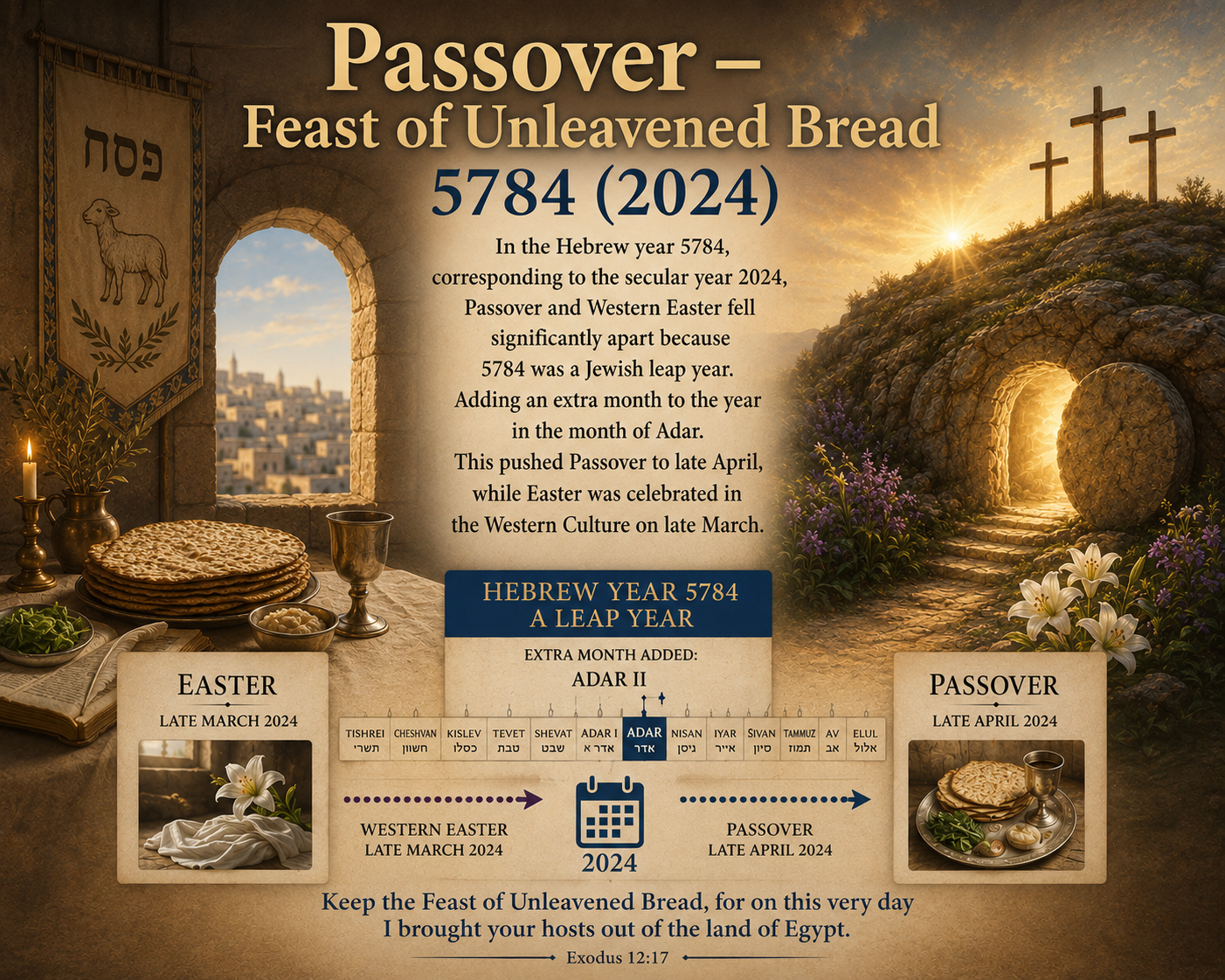
In the Hebrew year 5784, corresponding to the secular year 2024, Passover and Western Easter fell significantly apart because 5784 was a Jewish leap year. Adding an extra month to the year in the month of Adar. This pushed Passover to late April, while Easter was celebrated in the Western Culture on late March.
Video message
Shalom and a happy Passover. The fact that I am now wishing you a happy Passover may perhaps be confusing, as much of the Christian world has already commemorated the crucifixion and celebrated the resurrection. But if we look to the Bible – which must be the foundation of our faith – we know something. We know that the Messiah – for example, in 1 Corinthians chapter 15, the apostle Paul uses a Greek term corresponding to the Hebrew word Reshit, and Reshit is usually translated as ‘the firstfruits’. It refers to the day of the resurrection.
And that is why Paul also speaks in 1 Corinthians – but this time in chapter 5 – of the Messiah as our Passover Lamb. And indeed, when we study the New Covenant carefully, particularly the Gospels, we see that the Messiah was crucified on what the Gospels call the Day of Preparation, which is another name for Passover. It is therefore undeniable that Yeshua was crucified on Passover, which means that the resurrection must have taken place after the crucifixion. And yet I say to you: Happy Passover, for, biblically speaking, the Passover has not yet been celebrated in accordance with what we read in the Bible under the Law of Moses. Why, then, is there this difference of opinion?
Why all this confusion? Well, I’ll explain how Christianity in general – not all of Christianity; the Orthodox Church, for example, uses a different method of calculation – but the majority of the evangelical world determines when the Resurrection is celebrated. This is how they go about it. They wait for the spring equinox. When spring arrives, they also wait for another event, namely the first full moon after the spring equinox.
So why is that first full moon so important? Because Passover falls on the 14th day of the first month, and in every biblical month there is a full moon on the 14th day. Christianity therefore generally – not the Orthodox, but the vast majority of the Christian world – looks forward to spring, the spring equinox. They wait for the first full moon, and then, on the Sunday after those two criteria have been met, they proclaim the Day of the Resurrection. This is where the problem lies.
If we look at the Bible, we see that we are instructed to celebrate the Passover in spring. That is why Christianity awaits the spring equinox, but Judaism takes a slightly different approach, based on certain implications of God’s word. If we look at the biblical calendar, for example, we must recognise that it is based on the moon. The months, for instance, are determined by the lunar cycle. And we also know that Islam, for instance, follows exclusively a lunar calendar.
And what does that mean? It means that the month which is so special to them, Ramadan, keeps changing its position on the calendar: sometimes it falls in summer, sometimes in spring, then it shifts to winter, then to autumn, and then back to summer again. So it’s constantly shifting. Why? Because if we look at the lunar cycle and take 12 lunar cycles in a year – that is, 12 times that lunar cycle – this does not equal 365 and a quarter days, but 354 days. This is because a lunar cycle lasts 29 and a half days.
That is why there is a shortfall, which means that the intervals between their festivals will be shorter than a full year, and as a result they are pushed back. As I said: perhaps in spring, then in winter, then in autumn and then in summer. However, Judaism is based not only on the lunar cycle, but also on the solar cycle. Why? If we were to follow only the lunar cycle, Passover would not always fall in spring.
And to make this adjustment, the following happens: roughly every two or three years, there is a leap year. I’ve already mentioned 365 and a quarter days. In the Gregorian calendar, we see that every four years – because a quarter of four is one – an extra day is added. We call this a leap year. The same term exists in Judaism.
It is called Shana Me’ul Berit, which roughly translates as a ‘pregnant’ year. And roughly every two or three years, this year gives rise to an extra month. The twelfth month in the biblical calendar is called Adar. And in Judaism, every leap year we add an extra month, called Adar Bet, or Adar 2, which is a full month. This year has such a month – that is, a year in which we add an extra month, making the year longer.
Just one more month. And what will happen then? We have these differences. What I want to make clear to you now is this: when we look at the Messiah, the Bible states very clearly that he was crucified during the Passover. And we know one thing: we know that the Passover falls on the fourteenth day of the first month.
And many people want to know and ask the question: is Catholicism actually correct? And is it right that Christianity largely adheres to a Catholic interpretation known as Good Friday, namely that he was crucified on a Friday? And why do they do that? Well, they say it must be so because they were in a hurry to lay him in the tomb before the Sabbath. Before the Great Sabbath.
It only becomes truly clear when we study the Word of God. There is a difference between the seventh-day Sabbath, which the world calls ‘Saturday’, and a ‘Great Sabbath’ mentioned in the Gospel of John, chapter 19, verse 31. A ‘Great Sabbath’ is a festive Sabbath. There are therefore days that are regarded as Sabbaths, regardless of which day of the week they fall on. I shall give you an example of this.
A day of particular significance for our discussion is the first day of the Feast of Unleavened Bread. If you study what the Bible says about the Feast of Unleavened Bread, we are told that the first and last days of this feast, regardless of which days they fall on, must be treated as a Sabbath, a ‘Great Sabbath’, which means that you must not do any work. On these special days, the Sabbath law applies. Now read the Scriptures carefully, and once again, do not simply take my word for it because of my knowledge of the truth. Do your own research.
Look into it. Always listen, but verify the information. Check whether what is being said is actually true. For example, I’d like to invite you to take a look at the Gospel of Luke, chapter 23, and in particular the last two verses, verses 55 and 56. What does it say there?
We know that Joseph of Arimathea was there. He was the one who took Jesus’ body to bury him in his tomb. And the women who had come from Galilee – look at verse 55 – they were there and they saw the place where he had been laid. And then it says something; it says that they went – look at verse 56 – they went and bought spices and ointments. They prepared them; they bought the ingredients, the spices, to make the ointment, the anointing materials for his body, to give him a dignified burial. But what happens?
They had run out of time. They could no longer go shopping, prepare everything and go to the tomb before the Sabbath. And this was the usual Sabbath on the seventh day. So they bought the spices and prepared them before the Sabbath.
But if you look, for example, at the Gospel of Mark, chapter 16, verse 1, it says exactly the same thing, but it states that they did it ‘after the Sabbath’. What does that mean, ‘after the Sabbath’? After the Great Sabbath. So this is what we know: Yeshua was crucified on the 14th day of the first month that year.
It simply had to be a Wednesday. So that myth about Good Friday is exactly that: a false legend. There is no biblical basis for it. Why? Well, we know one thing for certain.
If we look at this, we see that the women went after the Sabbath, that is to say, after the first day of the Feast of Unleavened Bread. If He was crucified on a Wednesday – and I shall demonstrate this in a moment – then the first day of the Feast of Unleavened Bread must have been a Thursday. And it was – according to Mark 16:1 – only after that Great Sabbath, the first day of the Feast of Unleavened Bread, the 15th day of Nisan, that the women went out, bought the spices and made their preparations. But what happened before they could reach the tomb to anoint His body, as they had intended to do?
The Sabbath began. Which Sabbath? The ordinary Sabbath, the seventh day. And that means, therefore, that the women had to buy and prepare the spices on Friday in order to make the ointment with which his body was to be anointed. So if they bought the spices after the Great Sabbath, the fifteenth day of the month of Nisan, that fifteenth day must have been a Thursday.
They bought the spices on the 16th day, and the 17th day was the usual seven-day Sabbath, a Saturday. He was therefore not crucified on Good Friday. This is incorrect. It is not supported by Scripture. We see that he was crucified on the 14th day of the first month, which fell on a Wednesday that year.
Everyone was observing the Great Sabbath, the first day of the Feast of Unleavened Bread. No work was to be done, and so, according to Mark chapter 16, verse 1, after that Great Sabbath, the women went to buy and prepare the spices. And then, according to Luke chapter 23, verse 56, they were unable to reach the tomb to anoint his body, so they rested on the seventh-day Sabbath. And what happened then? Well, they went to the tomb on the first day of the week.
And what did they find? They found an empty tomb. What does that mean? He had already risen. And this is what we know: Yeshua lay in that tomb, as He Himself declared.
He spoke of the sign of Jonah, namely the resurrection. Jonah, for example, spent three days and three nights in the belly of the fish. And in the Book of Jonah it says that he went down to the realm of the dead, which means that Jonah died. And what happened? He rose again.
That is why the Messiah says that you will receive no other sign than the sign of Jonah. Jonah rose from the dead, and it was only after he had risen from the belly of that great fish that he began to serve God. We have experienced resurrection through the Messiah, and we are called to do the same and to serve God. So what we see from a biblical perspective is that the apostle Paul – I’d like to go back to 1 Corinthians 15 for a moment – refers to Yeshua twice using that Hebrew term. He uses the Greek word that means the same thing.
He refers to Yeshua as Reshit. Why? This indicates that he rose from the dead at the start of the counting of the Omer. This brings me to the next point I wish to discuss, namely the differences between what Judaism teaches and what the Bible says about this counting of the Omer. In contemporary Judaism, the counting of the Omer always begins on the sixteenth day of that first month.
That’s not right. Why? If you look at Leviticus chapter 23, where this celebration is described, we know something. We begin by counting the Omer, and before that, a number of things must first take place. First of all, the first day of the Feast of Unleavened Bread had to have been celebrated.
After that, we wait for the first Sabbath following the celebration of the first day of the Feast of Unleavened Bread. And the following day, which must be a Sunday, because when we say that we wait for the first day of the Feast of Unleavened Bread, the 15th day of that first month, and the first Sabbath after that 15th day is the Sabbath referred to in Scripture, and that is the day after the Sabbath which must be the first day of the week on which the counting of the Omer begins. That is why no date is given. Judaism is wrong when it assigns a date to the beginning of the counting of the Omer. The Reshit is never given a date. Why?
Because you have to follow a specific sequence. That sequence is very simple. As I said, you wait for the first day of the Feast of Unleavened Bread and the first Sabbath following that first day, and the day after that – and that is precisely the term, mim-ma-ho-rat has-sab-bat – the day after that Sabbath is when you start counting. This tells us unequivocally that the Messiah’s resurrection took place because he is called the Reshit by Paul, the firstfruits. It happened on the first day of the week.
Let’s pay very close attention now, because when does the first day of the week begin? Well, after sunset on Saturday, and that means the following: when the Sabbath is over, that seventh day ends at sunset, and then it is the first day of the week. And the Messiah rose on the first day of the week; I happen to believe that this was shortly after the end of the Sabbath, and so it is still the first day of the week. On Saturday, once it is dark, according to the biblical reckoning, it is no longer Saturday. It is the first day of the week.
And Yeshua rose on the first day of the week. When the women came to the tomb early on Sunday morning, they saw that He had already risen. The tomb was empty. And later we see that Mary Magdalene, having seen the empty tomb, met Yeshua later on. So we must be very clear about this.
So we are talking about the timing of Passover, the timing of the day of the Resurrection, and the correct time to begin counting the Omer. There are two ways to count the Omer. We begin on the first day of the week following the first day of the Feast of Unleavened Bread. We start counting, and we count 49 days; the following day is the Feast of Weeks, Shavuot, or Pentecost. Alternatively, we realise that we are not simply counting 49 days plus the following day, but that we are counting one week every seven days.
So it’s a matter of seven weeks. That is why, in Judaism, it is called Chag HaShavuot, the Feast of Weeks, because we count seven full weeks, and the day after that is Shavuot, or Pentecost. Pentecost refers to the Greek word for fifty. Seven full weeks therefore amount to 49 days, and the day after that is Pentecost, this feast, this day appointed by the Lord. I therefore hope that what I have just shared helps to clarify matters and to realise that this year, as it is indeed a leap year, that extra month – the second Adar – is observed.
That is why there is such a great difference between the time when the majority of Christians traditionally celebrate the Resurrection and the time when they speak of the crucifixion, which took place during the Passover. And do not forget: the Passover lasts only one day, the fourteenth day of that first month, but the Feast of Unleavened Bread lasts seven days. The Passover is the preparation for the Feast of Unleavened Bread, and that is why all four Gospels repeatedly state that the Messiah was crucified on Preparation Day. This tells us about the Passover. God’s word is therefore clear.
We can work out the dates, we can work out the days of the week, and we can work out what happened during this important period of the Passover and the Feast of Unleavened Bread, because God wants us to know the truth, so that we can live by the truth.
Once again, a happy Passover, and let us celebrate the Resurrection in the right way, in accordance with the truth of Scripture. I will conclude here. Shalom.
Dr Baruch Korman