Video Link
Useful information to support the video
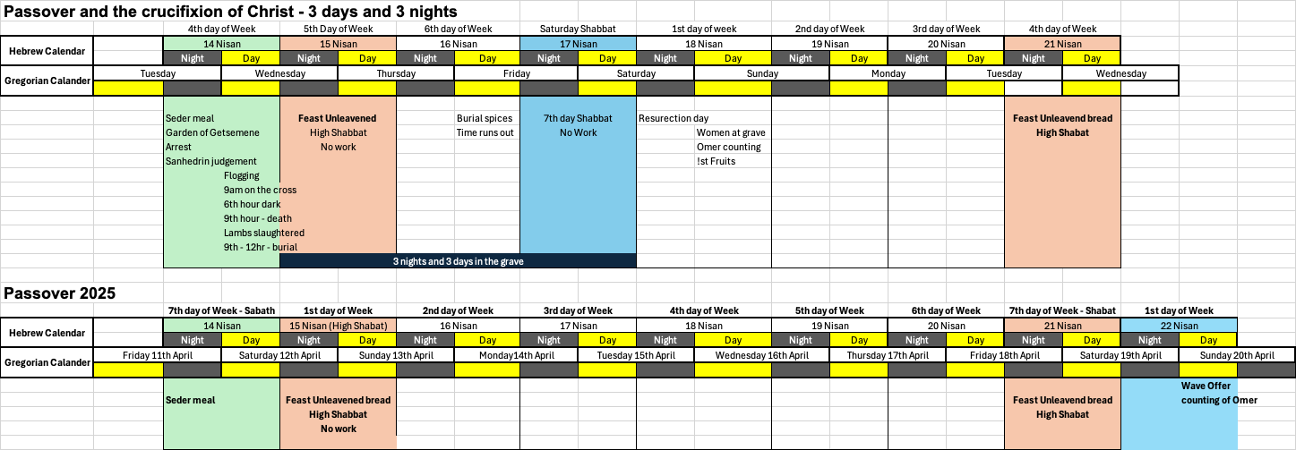
According to the Hebrew calendar, Passover (Pesach or the Day of Preparation) fell on the 14th day of the month of Nisan (Aviv) 5785 (2025), and the Feast of Unleavened Bread from the 15th to the 21st day of the month of Nisan (Aviv) (Hebrew year 5785). In the Hebrerw calander, days begin at sundown.
Therefore according to the Gregorian calendar, the observance of Passover, also known as Preperation Day, began at nightfall on the evening of Friday 11th April 2025 with the Seder meal and ended at sunset on Saturday 12th April. After sunset, begins the first day of the 7 day Feast of Unleavened Bread, with the 1st day and 7th day being a High or Great Shabbat, which this year the 2nd Day of Unleavened Bread occured on the normal weekly Shabbat. Since the 2nd day of Unleavened Bread took place after sunset on Friday 18th April, the Shabbat, and this Shabbat is also the 1st Shabbat after the 1st Day of Unleavened Bread means that the waveoffering of First Fruits and the counting of the omer, begins the day after the Shabbat, I.e Sunday 20th April, (22 Nisan). Therefore in this particular year there was no regular Sabbat within the Feast of Unleavened Bread.
See Adendum 1 for an overview of the Passover timeline at the time of Christ’s crucifixion and the Passover timeline for 2025
Video message from Dr Baruch Korman
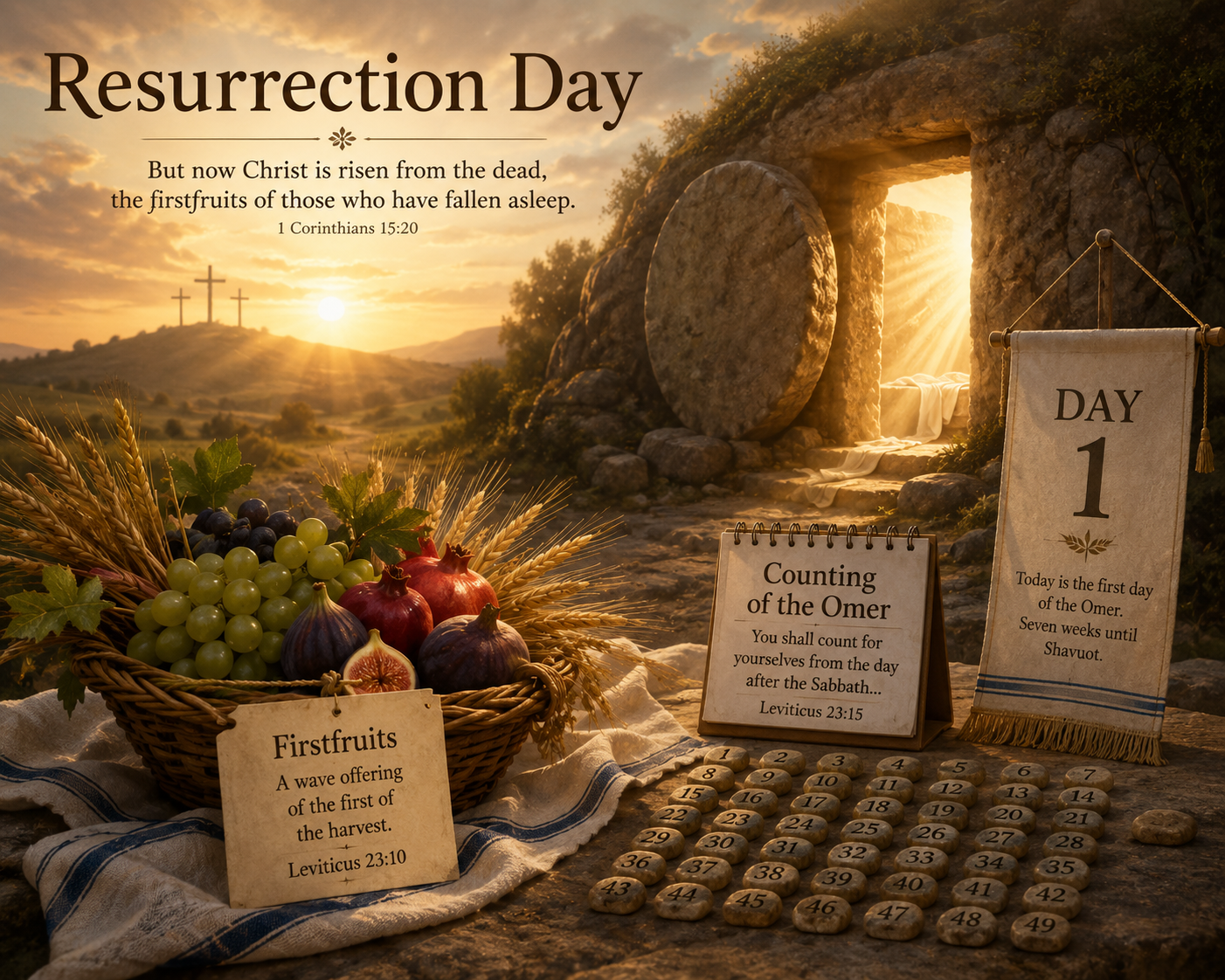
The day of Christ’s resurrection must take place on the first day of the counting of the Omer, the Day of First Fruits, which must always fall on the first day of the week (Sunday).
The most important event in the entire history of mankind is the resurrection of our Lord and Saviour, the Messiah Yeshua, Jesus Christ. Unfortunately, there is a great deal of confusion surrounding this event. On which day, for example, did it take place? If you are familiar with the Bible, the answer is quite clear. There is no room for dispute if we use the whole of Scripture to arrive at the correct answer.
Many people are now confused because, for example, this year we can see that there are many days between the moment He was crucified at Passover and the moment the Resurrection took place. Many people mistakenly assume that the day of the Resurrection falls on the third day. The problem is that, from a biblical perspective, this is incorrect. There is a biblical formula for determining when the Resurrection took place, and it can be found in Scripture. So let’s begin.
Please turn with me to the book of Leviticus, chapter 23. In this 23rd chapter of the book of Leviticus, we find a list of feast days. And the first thing you need to remember is this: these are not Jewish feasts, but according to Scripture, they are the feasts of the Lord. Or, to put it more literally, they are the days appointed by the Lord. Many of them relate to events that took place in the past, but there is also a future fulfilment, and that future fulfilment lies in the Messiah.
Let me give you another example of this from the Bible. In Colossians chapter 2, Paul discusses all sorts of matters, including these festivals, these appointed days. And what does Paul say? He says in Colossians 2 – and I’m quoting from verses 16 and 17 – that these feast days, alongside the other things mentioned in verse 16, are not intended for judgement, but that they are a shadow of things to come. When he speaks of things to come, he is referring to the Kingdom.
And then he tells us that the Messiah is the one who casts that shadow. That is why we learn two things from these feasts, these appointed days of the Lord. We learn about the Kingdom of God, and we also learn about the person and work of the Messiah. In other words, these feasts are very important. They ought to be studied by all believers, because the better we understand the feasts, the better we can understand, as I have already said, who the Messiah is, the person of the Messiah, and what the Messiah has done and will do.
I would like us to look at this 23rd chapter of Leviticus for a particular reason. If we look at verse 9, we see that the Lord speaks to Moses. He said to Moses: ‘Speak to the children of Israel, and say to them: When you enter the land that I am giving you, you shall bring a portion of the firstfruits to the priest. Now there was a special commandment that could only be observed when the people entered the land – that is to say, the Promised Land, the land of Israel – and it concerned a harvest. The people would go out to harvest, and we are talking about the first harvest, namely the wheat harvest. Some might say: the barley harvest. We are not concerned with the specific type of crop, but it is the first harvest.
And we see what happened. The owner of the field made a decision. On a certain day – the day we are about to discuss – he would go out to inspect the harvest. That is also the day on which the Messiah was raised from the dead. He was going out to inspect the crops – the barley, the wheat – and he could have chosen whatever quantity he wished: what was called the first of the harvest, or the first fruit, or, to use the word omer, which refers to the gathering of the harvest into sheaves. Now, this person was going to offer that as a sacrifice.
This is what Scripture goes on to tell us. And he did not do this solely through this grain offering, which he was to give to the priests as a firstfruits offering; there were other things he was to offer alongside it, including a wine offering, which we read about at the end of verse 13. Let us now turn to verse 15, Leviticus chapter 23, verse 15. It says here: ‘And you shall count the days for yourselves’ – this is very important – because when you count, there is a personal benefit. So it says: ‘you shall count for yourselves’.
And here is the expression: mim-ma-ho-rat has-sab-bat. The same term also appears in verse 11. That verse specifies on which day this special commandment concerning the firstfruits is to be observed. Both verse 11 and verse 15 state that we are to do this mim-ma-ho-rat has-sab-bat, that is to say, from the day after the Sabbath.
Here’s what you need to remember. In Rabbinic Judaism, the word ‘Sabbath’ is interpreted as the Great Sabbath, which refers to the first day of the Feast of Unleavened Bread. That first day of the Feast of Unleavened Bread falls on the fifteenth day of the first month. In the Bible, this month is called Aviv, whilst elsewhere in the Bible it is called Nisan. It is therefore the fifteenth day of the first month.
The following day, the day after that Great Sabbath—which would be the sixteenth day of the month—they said that this is when you start counting, and that this day must be observed. That is Rabbinic Judaism. But if we look at Scripture, that cannot be right. How do we know that? Well, Paul tells us in 1 Corinthians 15.
He says many things. It is a chapter devoted to the resurrection, and he says: if the Messiah has not been raised from the dead, then our faith is in vain, and we would be among the most wretched or most pitiable of people, because we have believed a lie and are proclaiming a lie. That is not a good thing. Therefore, because the Messiah has indeed been raised from the dead, our faith is not in vain. We are not to be pitied, and we do not proclaim a lie but the truth.
And here’s what’s interesting: if you look, for example, at this 23rd chapter of Leviticus, we see here in verse 12 that a day has been set aside for a wave-offering. Why is that important? Because the wave-offering symbolises victory. So God, in His providence, in His wisdom and with His perfect timing, ensured that the resurrection took place on a day that symbolises victory and acceptance for the people. Why do I say ‘acceptance’?
Because if you look at verse 11, it says: ‘and he shall wave the omer before the Lord’. Who does that? The priest, ‘so that it may be accepted on your behalf’. When does he do that? From the day after the Sabbath, the priest shall wave it. This waving symbolises, as I have already said, victory.
It symbolises the joy that God will receive the people in a special way. As I said, we find that same expression in verse 15. Look at verse 15, Leviticus 23: ‘And you shall count for yourselves’ – an important expression; there is a benefit for you. When? From the day after the Sabbath. The question now is this: in 1 Corinthians 15, in verses 20 and 23, Paul twice refers to the risen Messiah as ‘our first’.
Why is that? Through Him we have victory. Through Him we are reconciled to God. And through Him, death has not triumphed. Sin has not triumphed, but God has triumphed over sin and over death, through what the Messiah did when, on the day of redemption, He secured eternal salvation for us.
Why eternal salvation? Quite simply: if the blood of goats, sheep, bulls and calves was of any use, how much more so the blood of the Son of God Himself. That blood, the blood of God’s only-begotten Son, has redeemed us – that is to say: saved us to eternal salvation, through which we have eternal life. That is a cause for joy. That gives us hope.
That is what brings us victory. So all this is told to us in Scripture. Take another look at verse 15: ‘And you must count for yourselves from the day after the Sabbath.’ Now we know something. The Messiah rose from the dead – the Gospels are clear on this – on the first day of the week.
The fact that He rose from the dead on the first day of the week indicates that the Great Sabbath is not the Sabbath to which the Word of God refers, but rather the ordinary seventh-day Sabbath. And we can demonstrate this from Scripture. Read on in verse 15: “You shall count for yourselves from the day after the Sabbath, from the day you bring the omer of this wave-offering.” What are you counting? Shava, Shabbatot.
7 Sabbaths. Now, the term ‘Sabbath’ may in fact – and this is what the rabbis say – refer to a week, not to 7 specific Great Sabbaths or 7 ordinary Sabbaths, but to 7 weeks. Well, perhaps that is the case. And then it says, look at verse 16, ‘until the day after the seventh Sabbath’. This is where the problem lies, and this is where the rabbis are mistaken.
There are not seven Great Sabbaths during this fifty-day period. There are only two. One is that first day, the first day of the Feast of Unleavened Bread, which is a Great Sabbath. The other is the last day of the Passover, that day of the Feast of Unleavened Bread, the seventh day. That, too, is regarded as a Great Sabbath.
Those are the two – the first day of the Feast of Unleavened Bread and the last day of the Feast of Unleavened Bread – two Great Sabbaths. But if the term ‘Sabbath’ refers to the Great Sabbath, then we do not have seven of them, and that does not tally with the New Testament, which tells us that the Messiah was raised from the dead on the first day of the week. Therefore, the only way to interpret this correctly is that the day following the Sabbath is the typical seven-day Sabbath, which in English is normally called ‘Sabbath Day’. We therefore know that the Messiah rose from the dead on the first day of the week, on a typical – as we would call it today – Sunday. A Sunday.
Remember one thing: when does the biblical day begin? At sunset. Not at midnight, not in the morning, but when the sun sets. That is when a new day begins. Why?
Scripture states: ‘one evening and one morning—that is one day’. A day therefore begins in the evening and ends when the sun sets. We read here: ‘You shall count fifty days until the day after the seventh Sabbath.’ If you count seven weeks and then add the following day, that is the fiftieth day. And what is that?
That is Pentecost, or the Feast of Weeks. So let’s make one thing very clear. There is a fixed formula. The reason why many people get confused is that they think that, whenever we work out which day the Passover falls on, that is also the day on which He was crucified. That is correct.
Then we wait three days, and that third day is the day of the resurrection. That is not what the Bible says. What the Bible says is something quite different, namely this: the Messiah was crucified at Passover. And the day after is that first Great Sabbath.
If you look at the Gospel of John, chapter 19, verse 31, it says that those who buried Yeshua – I’m talking about Joseph of Arimathea and Nicodemus – hurried to complete his burial before the Great Sabbath. That is the fifteenth day of the month of Nisan, before it began at sunset. That is why we know something. The formula for determining when the resurrection took place: you take that Great Sabbath, the first day of the Feast of Unleavened Bread, the fifteenth day of the first month. You then wait until the following seventh day, that typical Sabbath, the typical day of rest.
And it is the following day, the first day of the week, which is Reshit. Sometimes there are only a day or two in between. In the year that the Messiah was crucified, there were indeed those three days and three nights. We then realise that the first day of the Feast of Unleavened Bread fell on a Thursday, and so we must wait until Thursday, Friday and the Sabbath. That makes three full days.
And then the Resurrection is celebrated on the day following the ordinary seventh-day Sabbath, because that is not determined by a number of days, but by… What is the formula? You wait until the first day of the Feast of Unleavened Bread, and then the first Sabbath after that – not the Great Sabbath, but the normal, usual seventh day of the week – following the first day of the Feast of Unleavened Bread; that is the Sabbath, it is the following day, and that is the Day of the Resurrection. If you follow that formula, you’ll always be correct from a biblical perspective. So let’s go through the formula again to determine when the Resurrection is celebrated. We wait until the first day of the Feast of Unleavened Bread.
At that moment, the Messiah was already in the tomb. Think of those two men, Joseph of Arimathea and Nicodemus: according to John 19:31, they hurried to lay Him in the tomb before that Great Sabbath. So they buried Him even before that Great Sabbath began. So what do we do? We wait until the usual seventh day of the week, that usual Sabbath, and then the following day, the day after the Sabbath, is the day of the resurrection.
Let me conclude with this: when did the Messiah rise from the dead? On the first day of the week. There is no doubt about that, but not early in the morning. For when Mary Magdalene went to the tomb whilst it was still dark, He had already risen. The resurrection therefore took place on the first day of the week, but none of the women who arrived there early in the morning witnessed it, because He had already been raised from the dead.
When was that? What we would call Saturday evening, but according to the biblical calendar, Saturday evening is the first day of the week. I hope this clarifies matters for you. May you have a blessed time during the Feast of Unleavened Bread and in the run-up to that wonderful feast day on which the Messiah was raised from the dead, which means that God has accepted that sacrifice. And that is why we shall share in that very same event: that we shall be raised from the dead and shall be like Him, and we shall serve Him, worship Him and please Him for ever and ever in His kingdom.
Glory be to God; He has done great things. He will do even greater things. And to all this we say: amen.
Dr Baruch Korman